Architecture
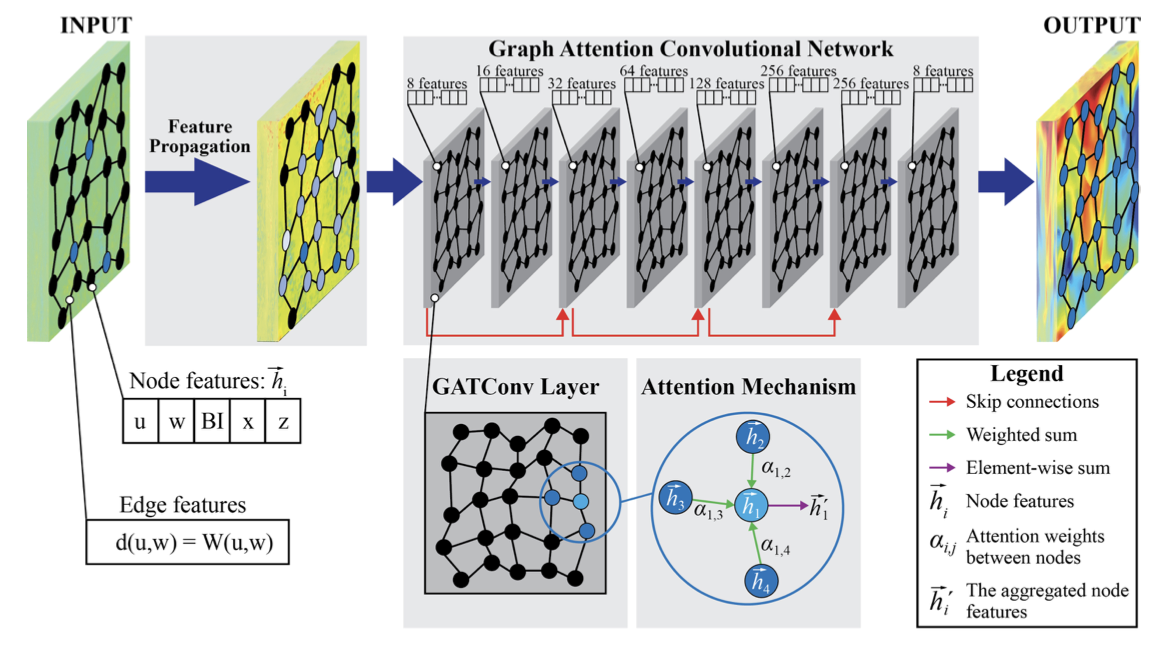
Our model, the Graph Attention Convolutional Network (GACN), treats each point in the flow field as a node in a graph.
Connections between these nodes allow information to travel naturally across space and time, respecting the underlying geometry.
The process begins with a Feature Propagation step, which fills in missing data by blending information from nearby sensors or known points.
A binary validity mask then teaches the network which parts of the data are observed and which are inferred, helping it make more confident and accurate predictions.
The network learns to “pay attention” to the most relevant neighbors when reconstructing flows, enabling it to handle unstructured meshes and time-varying boundaries gracefully.
Trained on high-fidelity simulations and tested on real Particle Image Velocimetry (PIV) experiments, it consistently outperformed classical interpolation and convolutional models.
The results show not only better numerical accuracy but also a deeper capture of fine turbulent structures — the subtle, beautiful details that make fluid motion so fascinating.
The success of this work points toward future applications where data and geometry meet seamlessly, from engineering design to environmental modeling.
